
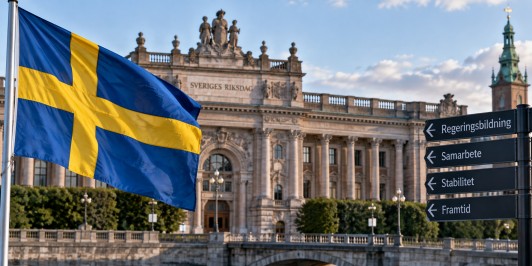
Sweden’s political landscape is in a state of flux as coalition negotiations have commenced following a tightly contested parliamentary election. The centre-left bloc, spearheaded by the Social Democrats, holds a slight advantage with 176 parliamentary seats compared to the right-leaning bloc’s 173 seats. With approximately 95% of the votes tallied, the final outcome will be determined once overseas ballots are counted later this week, leaving the composition of the future government uncertain.
Social Democrat leader Magdalena Andersson is actively engaging in coalition talks in an effort to form a new government. Meanwhile, outgoing Prime Minister Ulf Kristersson and his centre-right coalition are exploring avenues to retain their hold on power. The Centre Party emerges as a potential kingmaker in these negotiations, although its cooperation with the Left Party remains contentious due to policy disagreements. The Centre Party advocates for a stable government with a clear centre-right trajectory, firmly excluding collaboration with what it considers fringe political entities.
The potential for prolonged political deadlock is a concern, with several left-leaning parties advocating for governmental change. They warn that failure to form a stable government could trigger another election. The Sweden Democrats, who previously supported the right-wing government, have seen a decline in voter support and are unlikely to be part of the next administration. Despite this, their policies on immigration, integration, and crime have increasingly permeated mainstream political discussions.
As the Moderates and their allies await the final election results, Kristersson remains open to various possibilities for establishing a parliamentary majority. However, the Liberals and Christian Democrats have ruled out any cooperation with the Social Democrats. The Swedish parliament is set to convene on September 28, with the earliest opportunity for a prime ministerial vote occurring the following day. Should efforts to elect a prime minister continuously fail, Sweden might face the possibility of another election.
The process of forming a government in Sweden is expected to be lengthy, potentially spanning weeks or even months. In the aftermath of the 2022 election, it took 37 days to finalize a government, while the 2018 election saw negotiations stretch over 134 days. With no political bloc achieving a decisive majority, the roles of the Centre and Left parties could prove crucial in shaping the future leadership of Sweden.