
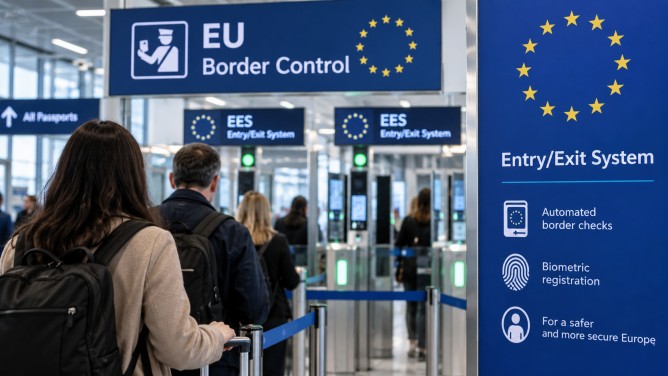
Nine European countries, including major travel hubs like France, Greece, Italy, and Portugal, are postponing the full rollout of the European Union’s Entry/Exit System (EES) due to ongoing challenges with implementing biometric checks at busy airports and border crossings. This decision comes as authorities seek more time to overcome technical and operational hurdles since the system’s official launch last October.
The EES mandates that non-EU travelers entering the Schengen area have their fingerprints and facial images recorded. While the system has already logged approximately 200 million registrations and blocked about 70,000 unauthorized entries—such as those lacking visas or overstaying their permitted duration—the implementation remains inconsistent across the EU. Countries like Germany, Malta, the Netherlands, Switzerland, and Belgium have also requested additional time for full integration, whereas Spain has successfully addressed initial challenges and moved forward with complete implementation.
Biometric checks have commenced at several entry points, including the Eurostar terminals in Brussels and the Antwerp port, yet many airports, particularly smaller ones, are still in the process of preparing the necessary facilities. Major international airports such as Frankfurt and Schiphol are already conducting biometric checks, but capacity and infrastructure issues persist at less prominent locations.
The delays in implementing the EES have drawn concern from the International Air Transport Association, which cautioned that the system could lead to extended wait times, especially during peak travel seasons. Airlines have echoed these sentiments, warning that prolonged queues could disrupt passenger flow.
To streamline the process, a pre-travel application known as Travel to Europe is being introduced, allowing travelers to submit passport details and facial images prior to arriving at the border. This application is currently operational in Sweden and Portugal, with plans to expand to other countries as efforts to enhance border control technology continue.