
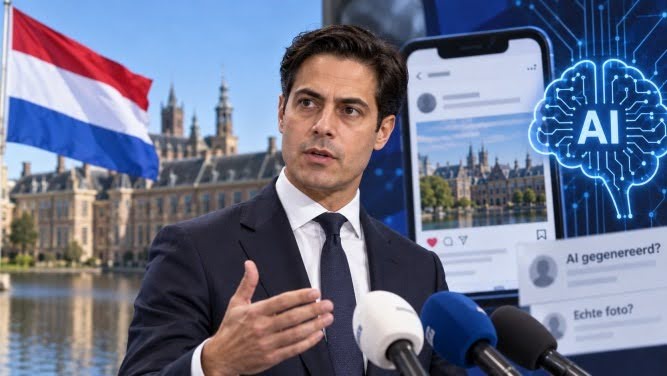
The Dutch political landscape is witnessing a new development as Prime Minister Rob Jetten and his D66 party have been found to utilize artificial intelligence for crafting hundreds of social media posts. This revelation has prompted concerns regarding the authenticity of these communications and the trust of the public in political messaging. An extensive analysis of 1,812 posts from Jetten’s and D66’s accounts across platforms such as X, Instagram, Facebook, and LinkedIn, dating back to 2021, identified at least 232 posts created with AI chatbots. Specifically, 68 of these posts were from Jetten’s personal accounts, while 164 originated from the party’s platforms.
The deployment of AI-generated content surged notably following the collapse of the Schoof I Cabinet in June 2025. Since then, approximately 30% of posts from both Jetten and D66 were discerned as AI-generated. Additionally, AI was employed in creating sections of Jetten’s book “Hoe het wél kan” and in scripting parts of three D66 campaign videos. The AI-assisted posts have attracted significant attention since some of them addressed delicate topics such as the conflict in Ukraine, the remembrance of the MH17 tragedy, and the Dutch government’s apology to the Moluccan community.
D66 has admitted to the use of AI in their social media strategy but assured that all generated content undergoes a review and refinement process by their staff. The party emphasized that posts on Jetten’s personal accounts are grounded in his own contributions and receive his final approval or edits. Despite these assurances, experts express concern that presenting AI-generated content as personal communication might undermine Jetten’s credibility.
University of Amsterdam professor Claes de Vreese highlighted the potential issue, noting that AI-generated language could blur the lines between a politician’s authentic opinions and computer-generated content. This situation underlines broader implications for transparency and the ethical use of AI in political communications, especially when official social media accounts are anticipated to convey the genuine views and statements of elected officials.