
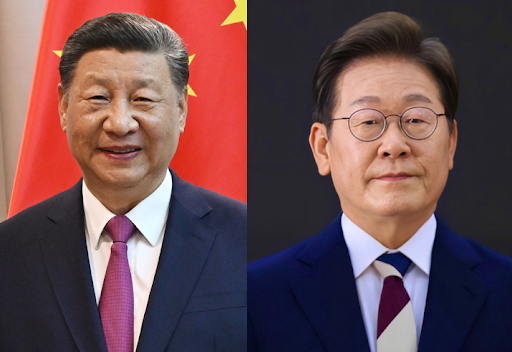
President Lee Jae Myung is navigating a political minefield, underscored by Chinese President Xi Jinping’s recent state visit to Seoul. The summit highlighted the immense pressures on South Korea, a nation balancing its vital security alliance with the United States against its profound economic dependence on China.
This delicate balancing act was immediately apparent as hundreds of protesters gathered in Seoul to rally against growing Chinese influence, even as President Lee hosted President Xi. Lee, who has faced criticism for attempting to curb such demonstrations, was forced to manage public discontent on one side and high-stakes diplomacy on the other.
During their talks, Lee tackled several sensitive topics. He formally raised the unresolved tensions stemming from the 2017 deployment of the U.S. THAAD missile system, a move that infuriated Beijing. He also brought up Chinese sanctions against a U.S.-linked firm, further highlighting the difficult space Seoul occupies between the two superpowers.
Furthermore, President Lee urged Xi to leverage China’s influence to help restart dialogue with a hostile North Korea. This plea for assistance was a central part of Lee’s agenda, aiming to de-escalate tensions on the peninsula. However, the request was almost immediately rebuffed by Pyongyang, which dismissed the effort as a “pipe dream,” showcasing the limits of diplomatic pressure.
Despite the political friction, the summit did yield economic results. Chinese state media emphasized the signing of seven new economic agreements, including a significant currency swap. For President Xi, the visit was a call for “mutual respect” to handle differences, a message delivered just after U.S. President Trump’s own visit, leaving Seoul to navigate the competing demands of giants.
Lee’s Diplomatic Minefield: Juggling Protests, China, and U.S. Alliance
Picture Credit: commons.wikimedia.org
26