
Iran’s foreign minister stepped onto the diplomatic stage on Saturday with one of the conflict’s most sweeping statements yet, calling on every Arab government in the Middle East to expel American military forces from their territory. The demand came as Iran was simultaneously launching ballistic missiles at the UAE, firing rockets at Israel, and threatening to strike any Gulf energy facility with American ties. The foreign minister argued that the US security umbrella in the region had proven to be a source of instability rather than protection, and that the time had come for Arab neighbours to choose a different path.
The statement was part of Iran’s broader campaign to isolate the United States diplomatically and raise the political cost of the war for American allies in the region. Gulf states hosting US bases found themselves in an increasingly uncomfortable position — targeted by Iran’s missiles on one hand, and reliant on American military protection on the other. The UAE, struck by Iranian missiles near its Fujairah oil port on Saturday, condemned the attacks as terrorism while maintaining it was still prioritising restraint and seeking a diplomatic resolution.
US warplanes bombed Kharg Island for the second consecutive day as President Trump said in public remarks the facility had been effectively demolished. He called on China, France, Japan, South Korea, and the UK to send warships to the Strait of Hormuz, which Iran had closed since the war began on February 28. The appeal was widely interpreted as the first public admission that the US might not be able to reopen the waterway unilaterally. Energy prices were approaching $120 per barrel, with analysts warning of further increases if the conflict continued.
Israel conducted dozens of airstrikes across Iran on Saturday, killing at least 15 people in an Isfahan factory. Iran fired rockets at Israel in return. US Defence Secretary Pete Hegseth described Iran’s leadership as “desperate and hiding” and claimed the new supreme leader had been wounded. Iranian officials confirmed the injury but called it minor. The International Crisis Group warned that the regime remained structurally intact and was pursuing a calculated strategy of survival and prolonged conflict designed to outlast American resolve.
The toll of three weeks of war was staggering. More than 1,400 Iranians had been killed in sustained bombing. Thirteen Israelis and roughly 20 Gulf residents had died. Lebanon’s crisis deepened, with 800 killed and 850,000 displaced from Israeli strikes on Hezbollah. Six US troops died in a military aircraft crash in western Iraq. The US embassy in Baghdad was struck overnight and Americans in Iraq were ordered to leave. With Iran’s foreign minister calling for a regional realignment and Trump refusing to negotiate, the diplomatic landscape looked as bleak as the military one.
Iran’s Foreign Minister Issues Stark Regional Warning as Conflict Widens
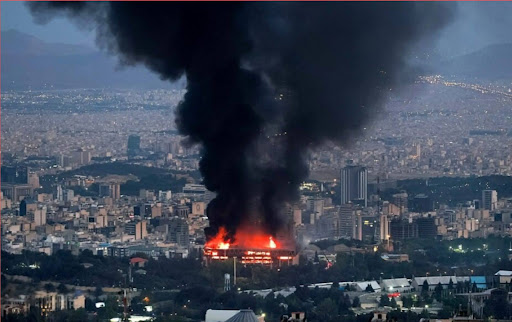
Photo by Mohammad Bornu / Avash Media / Wikimedia Commons (CC BY 4.0)
1